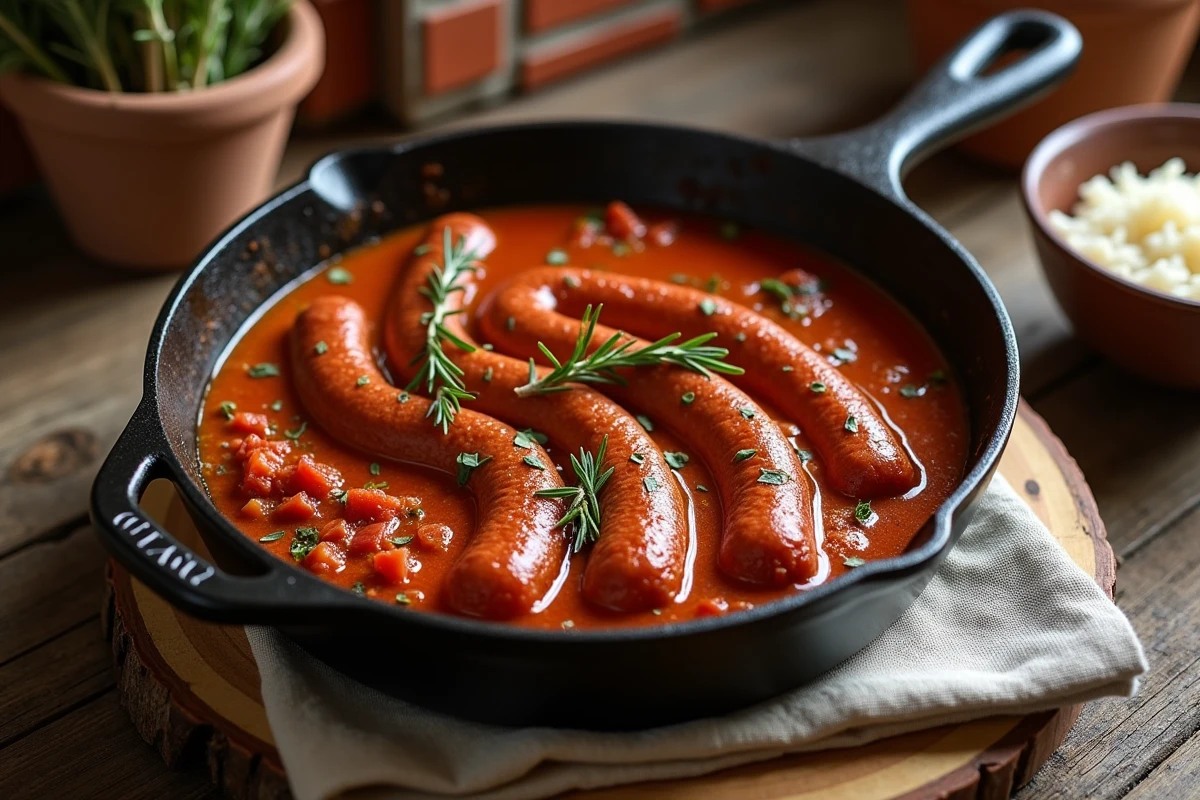
Sausage rougail is a dish from Réunion built on a base of tomatoes, onions, ginger, and chili, in which sausages simmer for a long time. The question of choosing between Toulouse sausage and Montbéliard sausage comes up with each preparation, as these two types of charcuterie react very differently to the spicy sauce.
Why sausage rougail relies on metropolitan sausages
Réunion has not developed a standardized local sausage for this dish. The island has inherited a supply of charcuterie linked to trade flows with the mainland, and Toulouse and Montbéliard sausages have established themselves due to their regular availability in distribution channels.
The Creole smoked sausage exists, but its production remains artisanal and its distribution limited to the island. On the mainland, reproducing a sausage rougail therefore relies on these two references that every supermarket offers. The rougail has adapted to the available sausages, not the other way around.
This pragmatism also explains why the recipe tolerates so many variations: the aromatic base (tomato, onion, ginger, chili) is powerful enough to absorb very different sausage profiles. To understand which Toulouse or Montbéliard sausage for a rougail best meets your expectations, one must first grasp what distinguishes these two types of charcuterie in terms of taste and technique.

Toulouse sausage and Montbéliard sausage: taste profiles in a rougail
Toulouse sausage is a fresh, non-smoked sausage made from coarsely ground pork. Its taste remains mild, almost neutral, allowing it to absorb the flavors of the sauce without competing with them.
Montbéliard sausage is smoked with softwood. It adds a woody aroma and a spicy note that complements the spices in the rougail. Its profile is more pronounced, more present in the mouth after cooking.
Interaction with the tomato-ginger base
In a rougail, the sauce concentrates acidic flavors (tomato), spicy flavors (chili), and warm flavors (ginger). The Toulouse blends into this mix: it absorbs the sauce and becomes a vehicle for flavors rather than a counterpoint. The result is homogeneous, with the sausage extending the sauce.
The Montbéliard plays a different role. Its smoking creates a contrast with the acidity of the tomato. Each bite alternates between the smoky taste of the meat and the liveliness of the sauce. The Montbéliard adds a dimension, while the Toulouse unifies the dish.
Cooking behavior: firmness and fat release
Sausage rougail requires prolonged simmering. Not all sausages react the same way to this cooking time.
- Toulouse sausage, fresh and coarsely ground, releases more fat into the sauce during cooking. This fat enriches the rougail but can make it heavier if the sausage is of average quality. Its texture softens quite quickly.
- Montbéliard sausage, already cooked during smoking, retains a firmer texture after simmering. It releases less fat and maintains a clean hold when sliced into rounds.
- Mixing both in the same rougail works: the Toulouse enriches the sauce with fat while the Montbéliard provides structure and smokiness. This combination is, in fact, common in Réunion.

Cutting and presentation
The Toulouse is cut into thick sections before cooking, as it tends to fall apart if the pieces are too thin. The Montbéliard can handle thinner slices thanks to its natural casing hardened by smoking.
For a rougail served on an individual plate, the Montbéliard provides a visually cleaner result. For a family-style serving in a casserole, the distinction matters less.
Choosing your sausage for a rougail based on the desired result
The choice depends on the style of rougail desired. Two approaches clearly emerge.
A mild and blended rougail, where the sauce and meat form a homogeneous whole, calls for Toulouse sausage. It is better suited if the dish is intended for palates not accustomed to smoky flavors, or if the rougail is already very spicy.
A rougail with flavor relief, where each component retains its identity, leans towards Montbéliard sausage. The smokiness structures the dish and stands up to the spices without dissolving.
Concrete selection criteria
- Check the composition: a good Toulouse sausage contains pork, salt, pepper, and few additives. The label “pure pork” is a first filter.
- For Montbéliard, prefer a sausage smoked with real wood rather than flavored with liquid smoke. The difference is clearly felt in the rougail after cooking.
- Size matters: a sausage that is too thin dries out during simmering. Choose sausages with a generous diameter so they remain moist in the center.
The question does not have a single answer. Sausage rougail is a dish that has always adapted to what was available, from Réunion stalls to supermarket shelves on the mainland. Toulouse or Montbéliard, the real criterion remains the quality of the sausage and its ability to withstand simmering without breaking down in the tomato sauce.