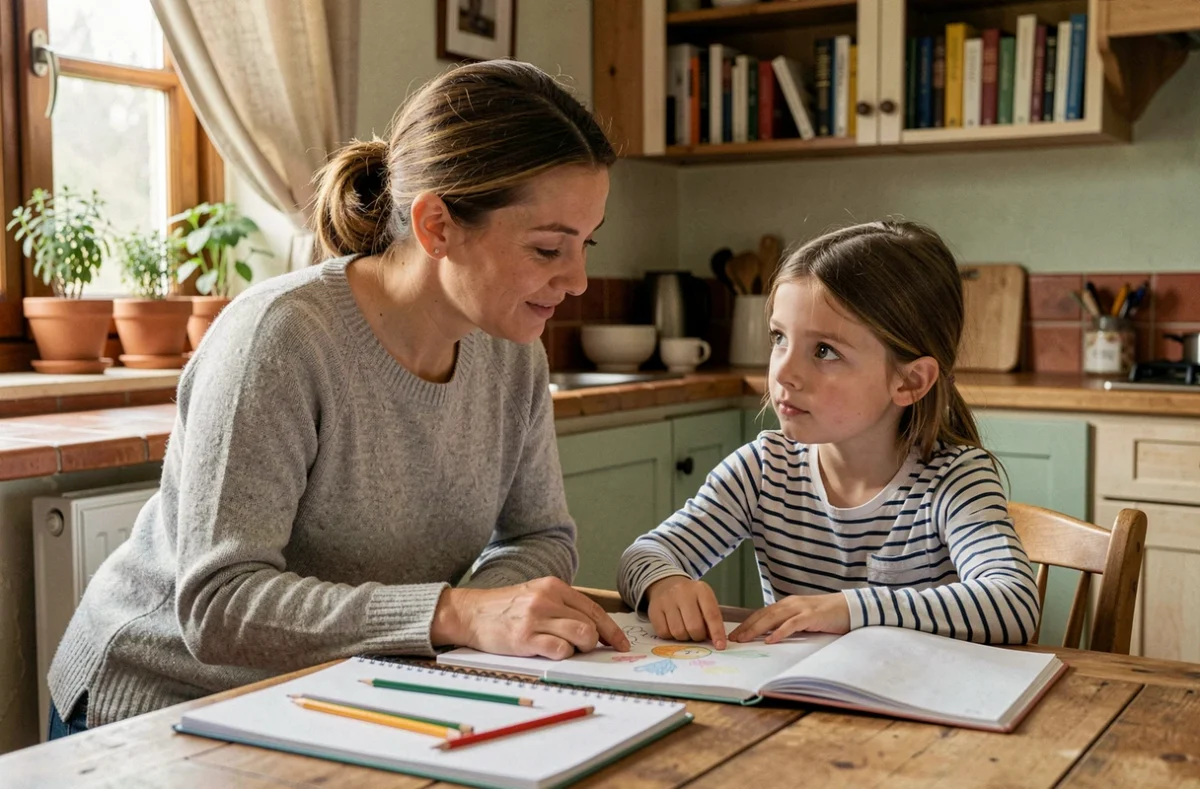
Supporting a child day to day takes more than educational techniques. The quality of a parent’s presence during everyday activities—meals, transitions, play—directly affects a child’s development, ability to concentrate, and emotional well-being.
France’s 1000 premiers jours program also recommends establishing routines and explaining the order of the day’s activities to children. This approach is based on a simple principle: until a fundamental need is met, a child cannot settle.
Emotional availability: the overlooked factor
Most parenting resources focus on what to do with a child. Few address the parent’s state of mind while doing it. A parent who is exhausted or distracted by their phone during a meal inevitably reduces the quality of the interaction, even if they are doing all the right things.
The official 1000 premiers jours website notes that feeding a baby can be an opportunity for interaction through touch, words, and eye contact. It also advises avoiding distractions such as television and phones so parents can be fully present. Emotional availability matters more than the number of activities and stimuli offered.
To help maintain this availability, the same program recommends surrounding yourself with supportive people and points to parent associations and groups as sources of help. Parenting support, then, also includes support between adults. Happy Licorne’s advice for children is among the resources that address this everyday relational aspect.

Children’s fundamental needs: five practical areas
When a child gets restless, shouts, or refuses to cooperate, the usual response is to look for a behavioral solution. An approach based on fundamental needs turns this logic around: identify what is missing before trying to correct what is spilling over.
| Need | Warning sign in the child | Appropriate parental response |
|---|---|---|
| Meaning | Lack of interest, refusal to take part | Show that you enjoy the activity yourself |
| Connection | Restlessness, constantly seeking eye contact | Get physically close and sit beside the child |
| Movement | Unable to sit still | Offer an active break before a quiet activity |
| Escape | Daydreaming, disengagement | Alternate structured activities with free time |
| Understanding | Repeated questions, frustration | Explain why, not just how |
A restless child is expressing an unmet need through their body. Words alone are not enough to calm them. A parent who moves closer and sits beside the child meets their need for connection more effectively than a verbal instruction shouted from another room.
Routines and transitions: structure without rigidity
Transitions—getting out of the bath, leaving for school, sitting down to eat—account for a significant share of everyday conflicts. A child has to move from an activity they are absorbed in to one they did not choose, without always understanding why.
Explaining the order of the day’s activities helps children know what to expect. This predictability does not eliminate resistance, but it reduces anxiety about the unknown. Talking through the day ahead gives a child a mental map.
A few tips for smoother transitions:
- Give your child a few minutes’ warning before changing activities, and say what comes next (“after your bath, we’ll read a story”)
- Keep recurring routines in the same order (morning, mealtimes, bedtime) to create stable reference points
- Give your child a small task during the transition (carrying their plate, choosing a book) to help them feel involved
A routine should not become a minute-by-minute schedule. The goal is to provide a clear framework, not to optimize every moment. A rigid routine can be just as stressful as having no structure at all.
Play and conversation: two everyday tools for development
Play, conversation, and cuddles are among the shared moments of enjoyment that the 1000 premiers jours program identifies as beneficial to a baby’s development. These gestures require neither special equipment nor specific teaching skills.
A common pitfall is turning every interaction into a learning exercise. Naming colors during play, correcting pronunciation every time, or piling on “educational” activities may come from good intentions, but can overwhelm a child with stimulation. Free play without a learning objective remains a powerful driver of development.
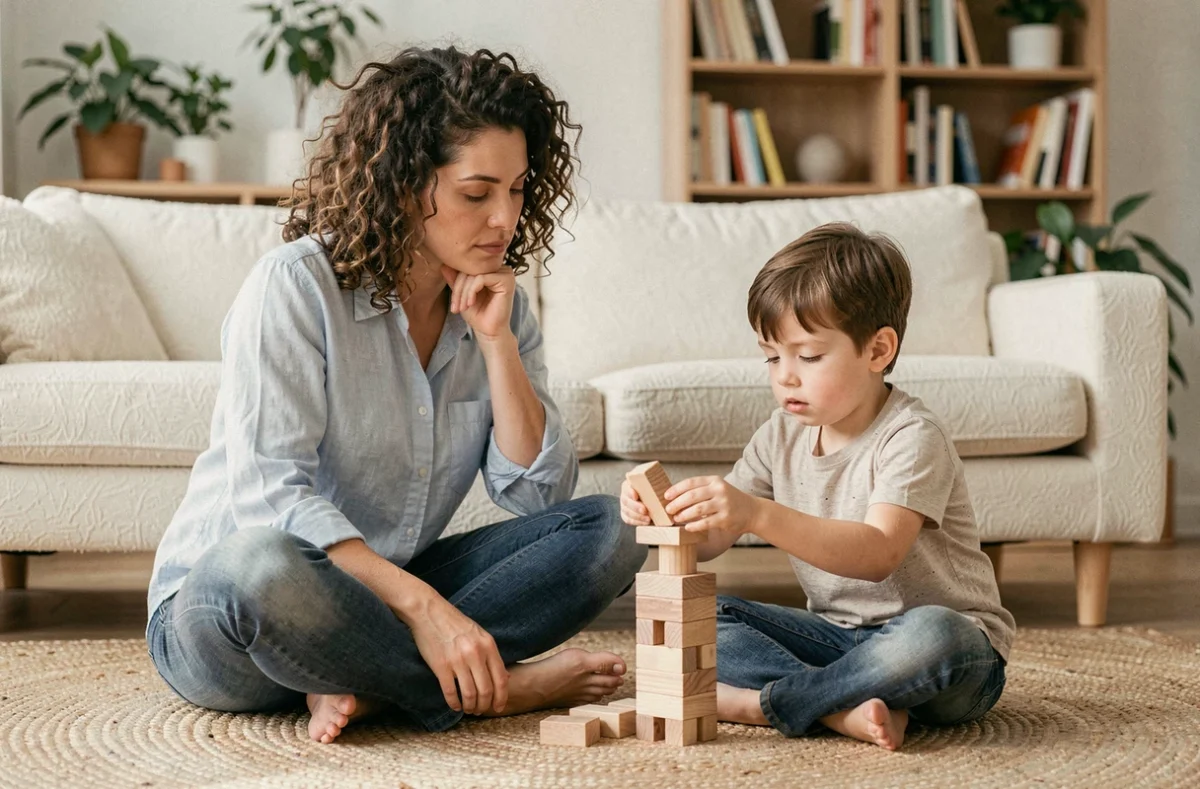
A child who stacks blocks and knocks them down ten times in a row is exploring gravity, cause and effect, frustration, and enjoyment. A parent who watches without stepping in, then briefly comments on what they see (“oh, they all fell down”), offers exactly what the child needs: attentive presence and a verbal reflection of their experience.
Age-appropriate communication
With an infant, eye contact and touch carry the interaction. Eye contact during a meal matters more than educational talk. As a child grows, words take over, but the principle stays the same: respond to what the child expresses rather than directing what they should feel.
A three- to six-year-old who tells a story out of order does not need you to reorganize it. They need you to listen to the end. You can naturally rephrase the story by repeating its key details with interest.
Everyday parenting support depends more on the consistency of these small interactions than on setting up elaborate programs. A parent who is present during everyday activities meets most of their child’s needs. Often, the rest takes care of itself.