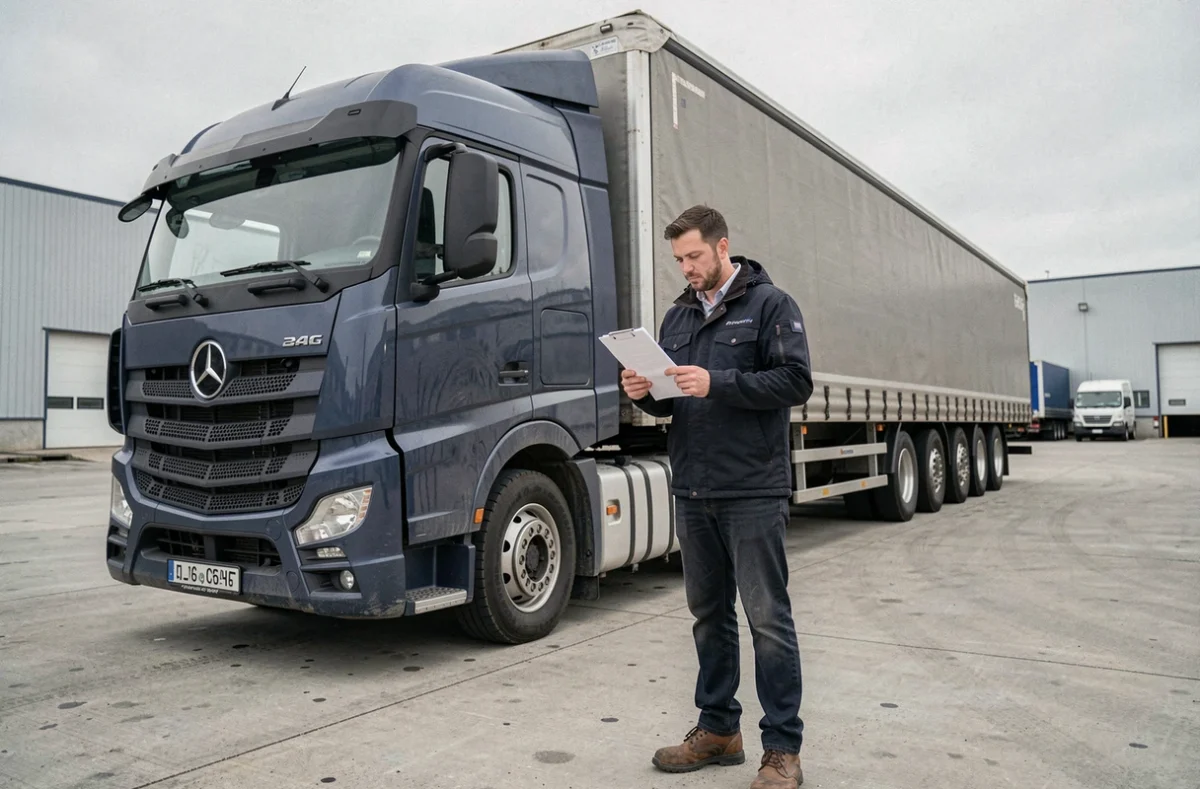
Coupling a trailer weighing more than 750 kg to a vehicle with a gross vehicle weight rating of 3.5 to 7.5 tonnes requires more than a standard C1 licence. You need an additional category: the C1E licence, which authorises you to drive these combinations up to a maximum gross train weight of 12,000 kg. Obtaining this category involves meeting several prerequisites, completing specific training and passing tests that are separate from those for the C1 licence.
GVWR, GTW and weight limits: what the C1E licence actually covers
Before discussing training or the test, it’s important to understand which vehicles this category covers. The C1E licence applies to two specific configurations.
The first is a vehicle with a GVWR between 3.5 and 7.5 tonnes (category C1), towing a trailer or semi-trailer weighing more than 750 kg. The second is a category B vehicle towing a trailer with a GVWR exceeding 3,500 kg.
In both cases, the authorised gross train weight of the combination must not exceed 12,000 kg. This 12-tonne limit is what distinguishes the C1E from the CE licence, which allows you to drive heavier combinations.
Why does this distinction matter in everyday use? Because a tradesperson or local haulier carrying heavy equipment on a trailer can quickly exceed the 750 kg limit permitted with a C1 licence alone. The C1E then becomes the only legal option for driving in compliance with the rules. Choosing a heavy vehicle training course for the C1E licence that suits your needs helps you plan your route from the outset.

C1E licence eligibility: prerequisites to check before enrolling
You cannot take the C1E test until you have met several requirements. Overlooking them can delay your training by several weeks.
- Hold a valid C1 licence. This is an essential prerequisite: without a valid C1 licence, you cannot enrol for the C1E.
- Be at least 18 years old, unless you are completing vocational driver training (a CAP, vocational baccalaureate or professional qualification, which can allow earlier access).
- Have a favourable medical assessment. The medical examination checks that you are physically fit to drive a heavy vehicle combination. If a limitation is identified, the category’s validity period may be shortened.
- For nationals of countries outside the European Economic Area: provide proof of lawful residence in France. EU, Swiss, Andorran and Monegasque citizens must have had personal or professional ties to France for at least six months.
One point that is often overlooked is the validity of the general theory test (the Highway Code). Passing it is valid for five years and also covers category C1E. If you took the test four years ago, check the date before scheduling your practical training.
C1E licence tests: how the practical exam works
The C1E licence exam does not include a separate theory test beyond the Highway Code test you have already passed. Training and assessment focus on the practical driving of a vehicle-and-trailer combination.
What the practical test assesses
Candidates must demonstrate that they can manoeuvre a vehicle-and-trailer combination in real traffic conditions. The test takes place on a manoeuvring area and on public roads in built-up areas.
On the manoeuvring area, exercises cover coupling and uncoupling the trailer, safety checks and reversing manoeuvres. Correctly coupling the trailer is a critical part of the test: failing to lock it securely or incorrectly connecting the brakes will result in failure.
On the road, the examiner assesses how candidates handle the challenges of driving a long vehicle combination: managing the overhang, allowing for longer stopping distances, and accounting for the vehicle’s dimensions when turning and navigating roundabouts.
Practical training: duration and content
Training takes place at an approved centre using vehicle-and-trailer combinations that meet the relevant standards. Each session alternates between manoeuvring-area exercises and real-world driving, allowing you to put technical skills into practice straight away.
The duration varies depending on the candidate’s experience. A driver who already has experience with a C1 licence will need fewer hours than someone who has only recently obtained their licence. Training centres adjust the number of sessions according to the candidate’s progress.

C1E licence validity and medical renewal
The C1E licence is not valid for life. Category C1E is valid for five years on your driving licence. After that, you must obtain a new favourable medical assessment to renew it.
Be careful not to confuse the expiry of the physical licence (the plastic card) with the expiry of the category. Your licence card may still be valid even though category C1E has expired. The expiry date is shown on the licence next to the C1E category.
The renewal medical examination is not something to put off until after your licence expires. Driving with an expired C1E category carries the same penalties as driving without a licence. Schedule your medical appointment several weeks before the deadline to avoid any interruption.
The C1E licence and a career in transport
The C1E opens up practical opportunities in local and regional freight transport. Deliveries with a trailer, transporting light machinery and supplying construction sites are among the jobs that require a vehicle combination exceeding the limits of a C1 licence alone.
For professional use, the C1E category often needs to be supplemented by FIMO (mandatory initial minimum training) or FCO (mandatory continuing training). These courses are governed by regulations separate from those for driving licences, but they are required for salaried employment in road transport.
The C1E licence is a targeted investment. It does not cover the heaviest vehicle combinations (which require a CE licence), but it meets most needs involving medium-sized vehicles. Checking your eligibility, keeping track of your theory test’s validity and planning ahead for your medical renewal are the three key steps to avoiding unpleasant surprises along the way.