
A mother’s speech at a secular ceremony does not follow the codes of a traditional wedding speech. It does not address an assembly to celebrate a couple; it fits into a ritual custom-designed, with a flow thought out by the officiant. This distinction changes everything: the tone, the duration, the positioning in the ceremony, and how the text interacts with other speeches.
Positioning of the mother’s speech in the flow of a secular ceremony
The mother’s speech never occurs at the same moment in different ceremonies. We recommend coordinating this choice with the officiant even before starting to write, as the placement in the flow conditions the tone of the text.
Placed at the beginning, just after the entrance of the couple, the speech serves a symbolic role: the mother entrusts her child. The tone remains contained, almost solemn. Placed at the heart of the ceremony, between the vows and a ritual (sand, candle, handfasting), it gains narrative freedom. Placed at the end, it becomes a send-off message, looking towards the couple’s future.
A text written without knowing its placement in the ceremony risks duplicating the officiant’s speech or competing emotionally with the couple’s vows. This is not a logistical detail; it is a prerequisite for writing.
Writing a mother’s speech for a secular ceremony gains coherence when the text is conceived as a piece of a whole, not as a standalone block.
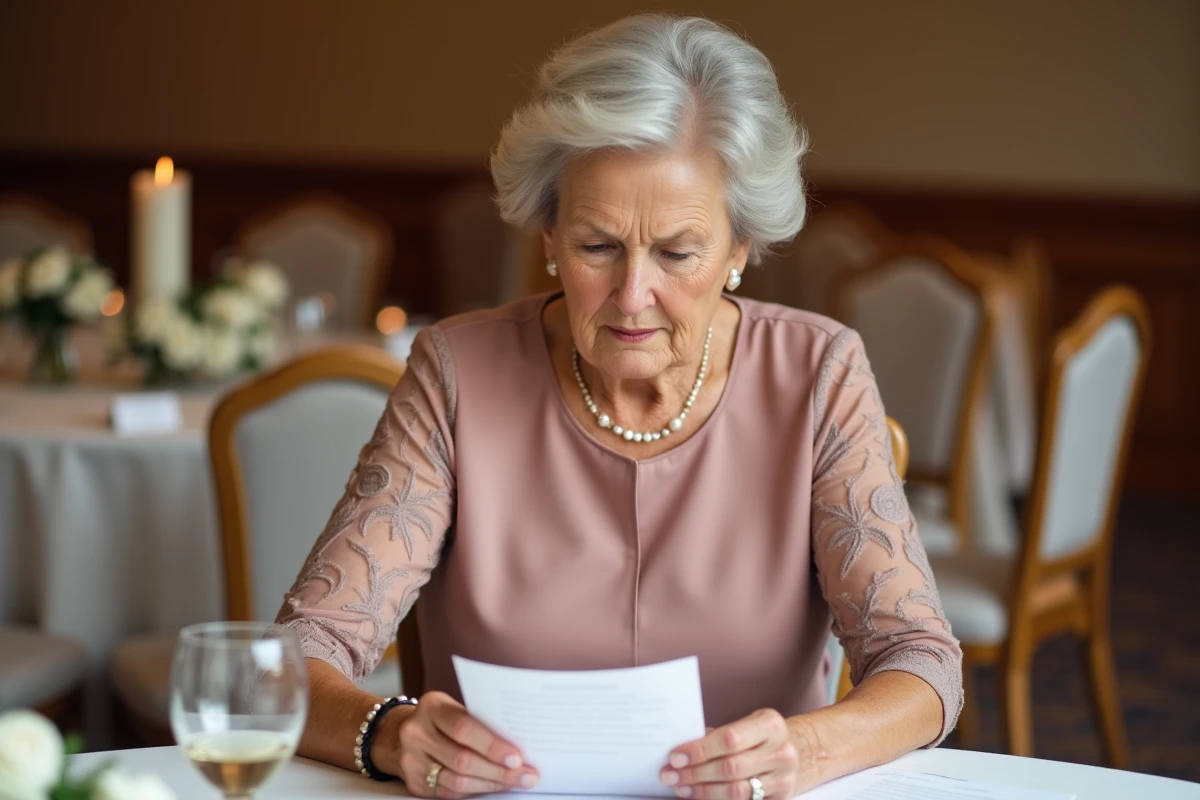
Writing a mother’s speech without falling into the generic model
Examples of speeches circulating online share an almost identical structure: childhood anecdote, declaration of love, welcome to the son-in-law or daughter-in-law, wishes for happiness. This skeleton works, but it produces interchangeable texts.
Finding the personal angle that anchors the speech
The most effective lever is not the accumulation of memories; it is the choice of a unique guiding thread. One overarching theme is better than five juxtaposed anecdotes. This thread can be an object (a book read every night, a passed-down recipe), a character trait observed since childhood, or a recurring phrase in the family.
This guiding thread gives the speech a narrative backbone. It also helps limit the duration: three to four minutes are more than enough in a secular ceremony. Beyond that, attention wanes, and emotion dilutes.
Emotional register and managing stage fright
We have observed in recent years a rise in “two-voice” speeches, where the mother shares the speaking role with her daughter or another family member. This format, increasingly offered by officiants, reduces stage fright and reflects the dynamics of blended families. It also allows for alternating registers (emotion and humor) without the mother bearing the full burden of the speech.
Another notable trend: the replacement of the oral speech with a letter read by the officiant. Wedding planners report that more and more couples are forgoing the speech if the mother is too anxious, preferring to entrust the reading to a third party. This choice respects the mother’s emotional consent without sacrificing content.
Concrete structure of a mother’s speech for a secular ceremony
A successful speech in a secular ceremony relies on three distinct blocks, the proportions of which vary according to the mother’s personality and the overall tone of the ceremony.
- The anchoring block (about a quarter of the text): an introduction that situates the relationship. No “dear guests, thank you for being here,” but a fact, a specific memory, a strong image. This block grabs attention and establishes the guiding thread.
- The transmission block (about half of the text): the heart of the speech. This is where the guiding thread unfolds, where memories make sense, where the mother speaks of what she has seen grow in her child. Each memory serves the guiding thread, not the other way around.
- The closing block (about a quarter of the text): the focus shifts to the couple. No list of abstract wishes (happiness, health, prosperity), but a sentence or two that extends the guiding thread into the future. A mother who has spoken about her daughter’s curiosity can conclude with what this curiosity promises for the couple.
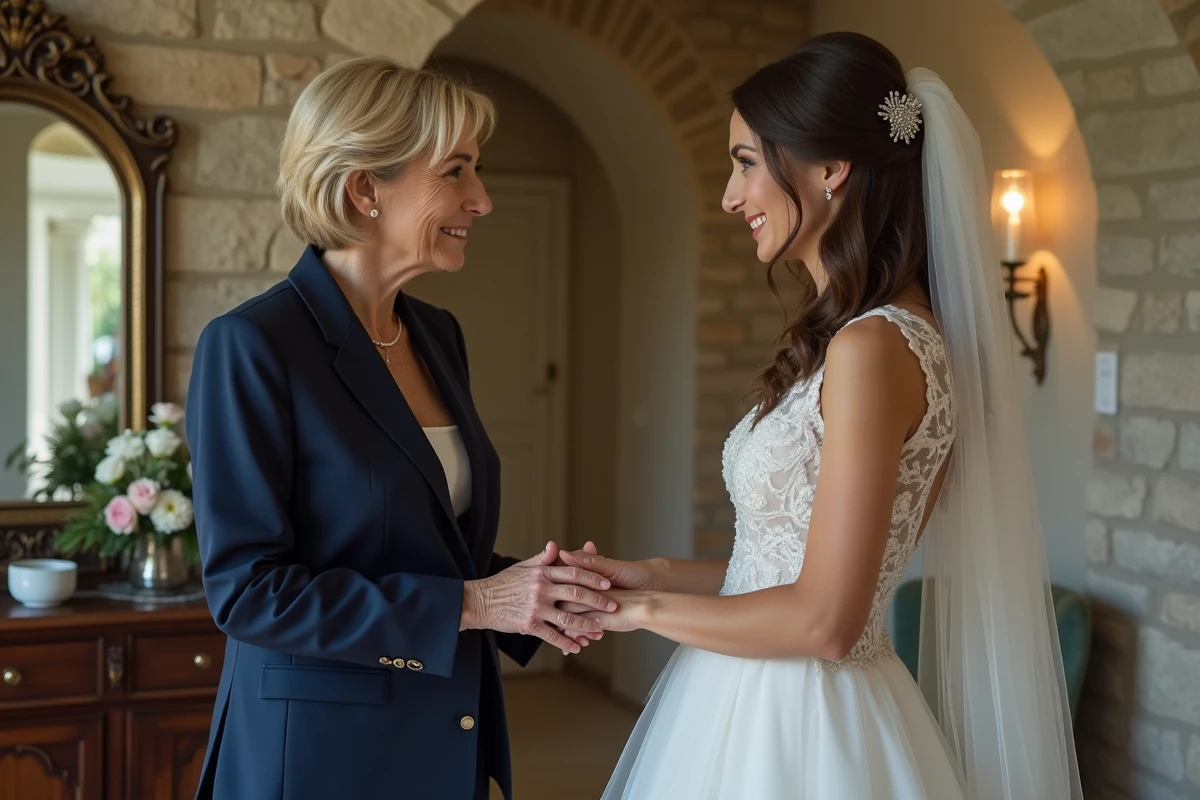
Technical mistakes to avoid in a mother’s speech at a ceremony
Reading a text word for word without ever looking up kills the emotion. We recommend a compromise: write the entire text, but highlight key passages so that you can detach from it during the reading and look at the couple.
The most common mistake remains the speech being too long. In a secular ceremony, every minute counts: the flow often includes four to six interventions (officiant, witnesses, relatives, rituals). A mother’s speech that exceeds five minutes disrupts the balance.
Another technical trap: mentioning absent people or painful family situations without having discussed them beforehand with the couple and the officiant. In a secular ceremony, the officiant manages the overall emotional coherence. Any sensitive mention must be validated in advance to avoid collective discomfort.
- Do not improvise an untested humorous passage: humor that falls flat in front of a silent audience amplifies stress.
- Do not address only your child while forgetting the partner: the speech speaks to a couple, not to a child alone.
- Do not use quotes found online without verifying them: many “famous quotes” about marriage are misattributed or invented.
A mother’s speech at a secular ceremony does not need to be perfect. It needs to be genuine, calibrated for the moment it occurs, and short enough for the emotion to remain intact until the last word.