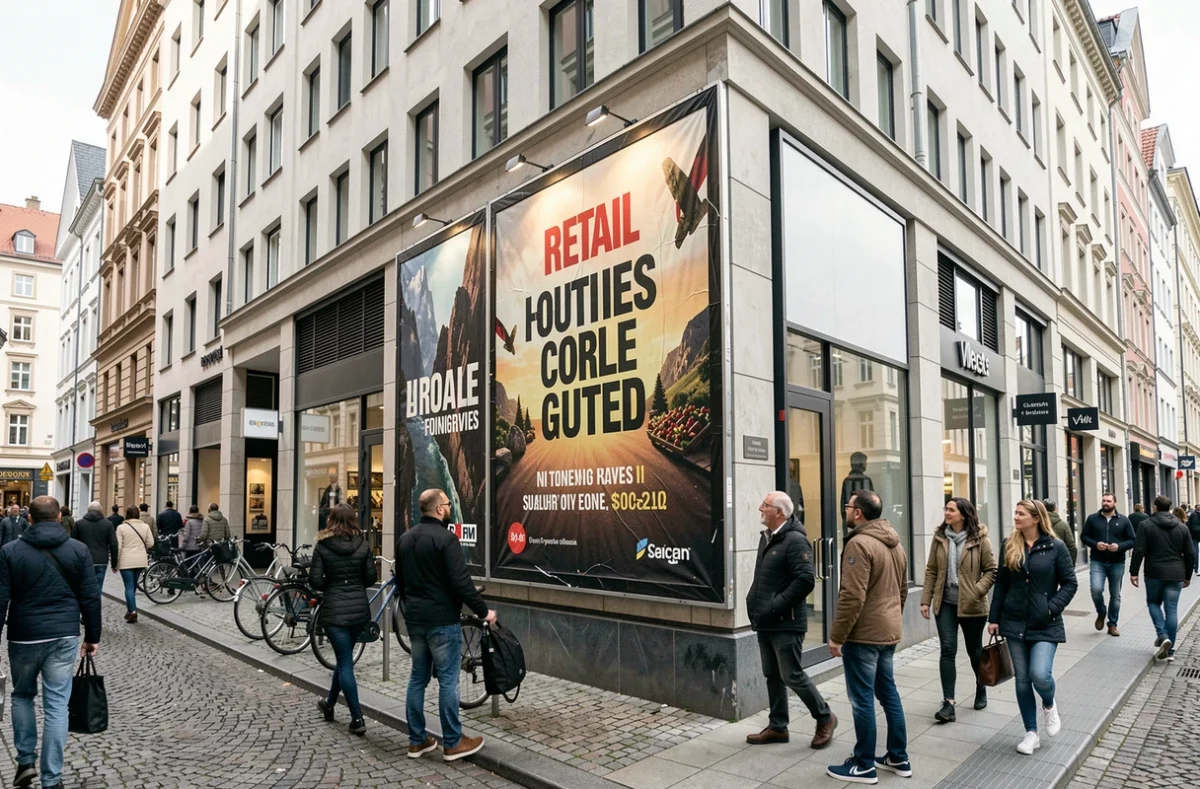
Advertising displays capture attention in public spaces without the recipient having to click, scroll, or accept a cookie. For a company looking to measure where to allocate its communication budget, the question arises in concrete terms: which channel offers the best balance between coverage, cost, and message retention? Comparing the available data on outdoor advertising, digital, and DOOH reveals significant discrepancies.
Outdoor Advertising, DOOH, and Online Advertising: Comparative Table of Characteristics
The three channels do not respond to the same broadcasting logics or measurement constraints. The table below synthesizes the structural differences based on the data available in the French market.
| Criterion | Classic Advertising (print) | DOOH (Digital Outdoor Advertising) | Online Advertising (display, social) |
|---|---|---|---|
| User Blocking | Impossible | Impossible | Active ad blockers among a significant portion of internet users |
| Geographic Targeting | Very precise (fixed location) | Precise, adjustable in real-time | Variable depending on platforms |
| Buying Mode | Reservation by network or location | Classic or programmatic reservation | Almost exclusive programmatic |
| Audience Measurement | Estimated (counts of pedestrian/vehicle flows) | Estimated (mobility data, sensors) | Individual (cookies, identifiers) |
| Message Exposure Duration | Several seconds (pedestrian/vehicle passing) | Several seconds per rotation | Often less than two seconds |
| Proximity to Point of Sale | Strong (neighborhood panels, bus shelters) | Strong (shopping centers, transit) | Low (personal screen context) |
What stands out from this grid is that physical advertising cannot be bypassed by the consumer. Ad blockers, which neutralize a growing share of online display campaigns, have no equivalent on the street. This unavoidable exposure constitutes the clearest structural gap between advertising and digital.
To delve deeper into the benefits of advertising displays, it is also essential to consider the proximity to the point of purchase, a parameter that online advertising struggles to replicate.
Share of Programmatic in DOOH: What Recent Figures Reveal
Digital outdoor advertising is often presented as a media in full transformation thanks to programmatic buying. The available data nuances this perception.
According to a study by the World Out of Home Organization published in September 2026, programmatic represents 16.7% of DOOH spending in France. This ratio shows that the majority of outdoor screen purchases are still made through direct reservations with agencies, on a model closer to classic advertising than online display.
This data has a practical consequence for advertisers. Programmatic buying allows for adjustments to creations based on time, weather, or foot traffic. However, it currently covers only a fraction of the market, meaning that real-time flexibility remains limited to certain networks of screens.
Limits of Audience Measurement in DOOH
DOOH impressions are calculated based on statistical models: mobility data, presence sensors, passage estimates. Individual exposure is not measured with certainty, unlike digital tracking which relies on individual identifiers.
The main factors of uncertainty concern:
- The actual visibility of the screen depending on the angle, ambient light, and weather conditions
- Audience duplication, as the same passerby can be counted multiple times on a daily route
- The attribution of sales, which is difficult to directly link to a DOOH exposure without complementary devices
For an advertiser used to digital dashboards, these limits can be surprising. They do not mean that advertising is less effective, but that direct comparison of KPIs between channels requires caution.
In-Store Advertising: Measurable Link to Purchase Action
One of the least addressed angles in guides on advertising concerns retail DOOH, that is, screens installed directly in stores or in their immediate vicinity.
The study “Fnac Darty Shopper Journey 2025” provides a concrete element: more than one in two shoppers states that in-store advertising influenced their decision. This figure places in-store advertising in a category of its own. It is no longer about awareness or memorization, but a declared link between exposure to the message and the act of purchase.
This result can be explained by the context of reception. A consumer who sees an advertising screen in-store is already in a purchasing mindset. The advertising message intervenes at a moment when the decision is not yet fixed, giving it a greater leverage effect than a banner seen on a news site.
Declining Revenues for Traditional Advertising
The overall picture of the outdoor advertising market is not uniformly positive. Net revenues from outdoor advertising decreased in 2025 compared to 2024, despite the growth of the DOOH segment. This decline mainly affects traditional printed formats (4×3 panels, static urban furniture).
For a company planning an advertising campaign, this trend has a direct implication: premium placements on digital media are negotiated at rising rates, while printed panels can offer more accessible conditions, with still effective local coverage.
Criteria for Choosing an Advertising Format for a Local Campaign
Rather than a list of formats, here are the parameters that determine the relevance of a medium:
- The speed of passage in front of the panel: a pedestrian has several seconds to read, a motorist less than two. The amount of text and font size must adapt to this contact time
- The distance between the medium and the point of sale: a panel located less than five minutes from the store captures an audience already in the catchment area
- The duration of the campaign: a product launch requires rapid rotation of visuals (advantage DOOH), while institutional communication benefits from remaining visible for several weeks (advantage print)
- The available budget: classic advertising remains the format with the lowest cost per contact for targeted geographic coverage
The choice between print and digital is not just a question of modernity. It depends on the available exposure time, proximity to the point of purchase, and the frequency of message renewal. A well-placed printed panel near a local business generates daily repetition that few digital channels can match at a comparable budget.